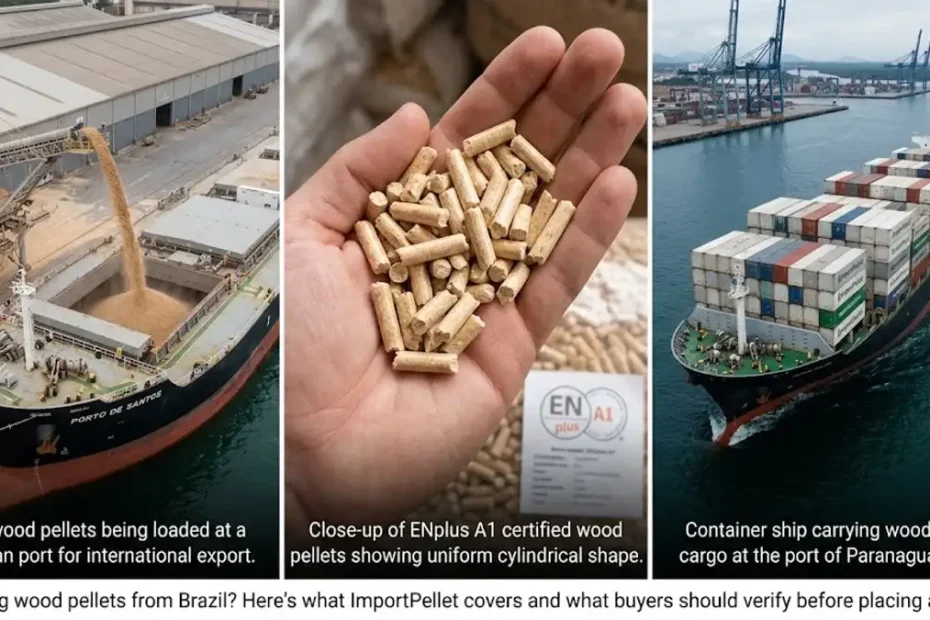
TL;DR: ImportPellet is Mello Commodity’s research brand helping international buyers investigate Brazilian wood pellet suppliers. This guide explains what the resource covers, how the import process works, and what buyers should verify before placing an order.
ImportPellet is the wood-pellet sourcing and import research brand operated by Mello Commodity to assist international buyers in evaluating suppliers based in Brazil. Its central resource, the Brazilian Wood Pellet Suppliers Guide 2026, compiles research on 17 Brazilian producers, exporters, and trading companies into a single reference document. The brand does not function as a certification body, an online marketplace, or a procurement service that purchases and ships fuel on behalf of buyers. Its role is to organize supplier discovery and outline the verification steps a buyer should complete before entering commercial negotiations.
The term can also describe the broader commercial process of importing compressed wood pellets for heating, industrial combustion, and biomass energy generation. This dual usage explains why some industry articles treat ImportPellet as a trade concept while others connect it specifically to the Brazilian sourcing guide. Understanding this distinction helps buyers determine whether they need structured supplier research or a comprehensive import execution plan.
Quick Overview
- ImportPellet is a research and educational resource, not a fuel supplier or certification scheme.
- The 2026 guide profiles 17 Brazilian producers, exporters, and trading companies.
- Brazil exported approximately 449,000 tonnes of wood pellets in 2025, with Italy as the leading destination.
- Buyers must independently verify certifications, production capacity, and commercial terms.
- Buyers should budget for the full import expense — freight, tariffs, third-party inspection, and handling — rather than focusing on the mill price alone.
- Quality standards such as ENplus A1 define measurable properties including moisture, ash, and durability.
What Is ImportPellet and Who Is It For?
Mello Commodity uses ImportPellet for its educational content and supplier research directed at overseas buyers interested in sourcing wood pellets from Brazil. The resource focuses on helping buyers identify potential suppliers, understand quality and sustainability requirements, compare commercial offers on a consistent basis, and prepare structured questions before initiating contact. A buyer still reaches out to the selected company directly, negotiates the purchase agreement, arranges independent inspection, and manages the shipment through their own logistics partners.
A supplier research guide and a fuel exporter perform fundamentally different functions. A guide like ImportPellet can reduce the time spent locating and screening companies, but it cannot guarantee a listed supplier’s current production capacity, product quality, financial stability, or delivery reliability. Buyers should treat it as a starting point for due diligence rather than proof that any specific company can fulfill their order. The responsibility for verifying claims, confirming certifications, and securing contractual protections remains with the importing business.
The resource is most useful for buyers who are new to the Brazilian market or who want a structured framework for comparing multiple suppliers before committing to negotiations. It is less relevant for companies that already have established supply relationships or that require a turnkey procurement service handling every step from factory to warehouse.
What the Brazilian Wood Pellet Suppliers Guide Covers
The 2026 edition profiles 17 Brazilian businesses selected for their relevance to international buyers, with companies organized by their commercial role in the supply chain. This categorization matters because a pellet producer manufactures fuel at its own facility, an exporter manages overseas sales and shipping documentation, and a trading company may coordinate purchases between manufacturers and buyers without owning production assets. Knowing which role a company performs helps a buyer ask the right questions about production control, export track record, and responsibility for cargo quality during transit.
The guide is designed to move research toward a productive supplier conversation. Its stated contents include business contact information, evidence of international-market activity, ENplus certification details where applicable, a structured request-for-quotation template, and a due-diligence checklist. Buyers can use the RFQ template to request comparable information from each supplier instead of sending informal messages that produce inconsistent and difficult-to-compare quotations.
The guide does not replace independent verification. Company details, contact information, certificates, production availability, and commercial terms change over time, so buyers should reconfirm every critical detail before signing a contract or transferring funds. ImportPellet also does not act as a customs broker, quality inspector, freight forwarder, or legal adviser for the destination market. Those functions require separate professional services arranged by the buyer.
Why International Buyers Are Sourcing Pellets from Brazil
Brazil has emerged as a significant origin in the international wood-pellet trade, supported by its extensive forestry sector and large wood-processing industry. The country exported approximately 449,000 tonnes of pellets in 2025, with Italy receiving close to 70% of that total volume. This growing trade activity gives importers a practical reason to evaluate Brazilian suppliers, although export growth at the national level does not prove that any individual producer can meet a specific buyer’s volume, quality, or delivery requirements.
Italy imported roughly 348,000 tonnes of pellets from Brazil in 2025, representing an increase of about 11% compared with the previous year. Brazilian feedstock commonly includes residues such as sawdust and wood shavings from timber processing operations, while eucalyptus and pine remain important plantation species supplying the country’s wood industry. Export routes may involve ports such as Paranaguá, Itapoá, Santos, and Rio Grande, though the optimal route depends on the factory location, vessel schedule, destination port, and prevailing freight rates.
The global demand for biomass energy continues to expand, and the International Energy Agency reports that bioenergy remains the largest source of renewable energy worldwide, with wood pellets playing a growing role in both residential heating and industrial power generation. This macro trend underpins the interest in new sourcing origins like Brazil. However, buyers should compare Brazilian offers with suppliers closer to the destination market and include freight, handling, duties, and delivery time in the comparison. The right origin meets the required specification at a reliable total landed cost, not simply the lowest factory price.
Wood Pellet Quality Standards and Certification Checks
Once you have identified a potential origin and a shortlist of suppliers, the next critical step is understanding what quality actually means in the pellet trade — because a low price means very little if the fuel does not meet the technical requirements of your equipment or market.
Wood pellets are compressed cylindrical fuel manufactured from woody material such as sawdust, shavings, and other processing residues. Manufacturers dry the feedstock to a low moisture level and press it through a die to produce uniform pieces compatible with pellet stoves, boiler systems, and industrial combustion equipment. The required grade depends on the end-use application and whether the buyer needs residential-grade fuel or industrial-grade material for large-scale energy production.
ENplus A1 is the premium quality class within the ENplus certification scheme, and its requirements address measurable physical and chemical properties rather than appearance alone. Key specification limits include moisture content of no more than 10%, ash content of no more than 0.7% on a dry basis, mechanical durability of at least 98%, and a diameter of 6 mm or 8 mm within a defined tolerance. Buyers should also request data on fines content, bulk density, and net calorific value because these properties directly affect handling behavior, feeding system performance, storage stability, and heat output.
A certificate must belong to the correct legal entity and remain valid for the specific activity the supplier claims. Buyers should check the company name or ENplus ID in the official certification database, confirm whether the certificate status is active, and review the scope to ensure it covers the production site and product category in question. Requesting a recent laboratory report for the actual production batch is equally important, because a supplier’s general certification does not prove that every individual shipment meets the agreed specification. The U.S. Department of Energy notes that wood and pellet heating systems require fuel meeting specific quality standards to operate efficiently and safely, reinforcing the need for batch-level verification rather than reliance on a single certificate.
Preparing for Your First Supplier Conversation
With a clear specification and quality benchmarks in hand, you are now ready to approach suppliers — and how you structure that first interaction will determine whether you receive useful quotations or vague promises.
Write a detailed product specification before contacting any supplier. State the required quality class, pellet diameter, packaging format, order volume, destination port, delivery window, and any sustainability documentation your market demands. Providing each supplier with the same brief produces quotations that can be compared on a like-for-like basis, reducing the confusion that arises when suppliers interpret vague requests differently.
Use the ImportPellet research to build a shortlist, then verify each company’s legal identity and commercial role independently. Ask whether the company owns the production facility, operates as an exporter of another manufacturer’s pellets, or trades fuel produced by third parties, and request evidence of previous international shipments. Confirm the registered company address, official contact details, stated production capacity, bank beneficiary information, and willingness to allow independent inspection before payment is released.
Send a formal request for quotation that asks every shortlisted supplier to price the identical specification and delivery basis. Request a sample or recent batch analysis report, agree on acceptable quality tolerances, and define how an independent inspector will verify quality, weight, packaging integrity, and loading condition at the port of origin. Incorporate the agreed specification, delivery schedule, claims procedure, inspection rights, and payment milestones into the contract before booking freight or issuing a purchase order.
Understanding the True Cost of Pellet Imports
A factory price represents only one component of the amount an importer ultimately pays. The full landed cost can include inland transport from the mill to the port, export handling charges, ocean freight, marine insurance, destination port fees, customs duties, taxes, broker fees, independent inspection costs, and final delivery to the buyer’s warehouse. Currency fluctuations and seasonal variations in freight demand can also alter the economics of a shipment between the time a quotation is received and the time the cargo actually sails.
Compare competing offers using the same Incoterm, quantity, packaging format, loading window, and destination assumptions. FOB generally means the seller delivers the goods on board the nominated vessel at the named port of shipment, while CIF includes cost, insurance, and freight to the named destination port, subject to the precise terms of the contract. Comparing an FOB price directly with a CIF price produces misleading conclusions because the included services and cost responsibilities differ substantially between the two terms.
A practical landed-cost calculation divides the total purchase and logistics expenditure by the tonnes received in acceptable condition at the destination. Include inspection and handling costs in the comparison rather than treating them as separate overhead, and allow for any loss or damage that could reduce the usable quantity. A low quotation can become an expensive purchase if the cargo arrives late, contains excessive fines, or fails the agreed quality test upon arrival.
Shipping, Documentation, and Storage Requirements
Most commercial pellet shipments require a commercial invoice, packing list, bill of lading, and customs declaration, while a certificate of origin may support an origin claim or a tariff preference depending on the trade agreement in force. Authorities in the destination country may also request phytosanitary documentation or other evidence related to plant health and legal sourcing. Wood pellets commonly fall under HS subheading 440131, but importers must confirm the correct national tariff code and current regulatory requirements with their customs broker before the shipment departs.
Pellets can move in retail bags, large bulk bags, shipping containers, or bulk vessels depending on order size and the capabilities of the receiving facility. Protecting cargo from rain and condensation is essential because moisture causes swelling, breakage, and excessive dust generation that degrades fuel quality. Buyers should agree in advance who bears responsibility for packaging standards, dry container provision, ventilation requirements, and damage discovered at the point of arrival.
Storage demands attention beyond simply keeping the product dry. Bulk wood pellets can release carbon monoxide, reduce oxygen levels in enclosed spaces, and create combustible dust concentrations, so warehouse operators must follow site-specific ventilation, gas-monitoring, dust-control, and confined-space entry procedures. A buyer should confirm that the receiving facility has the equipment, training, and safety protocols required for the planned volume before a vessel is scheduled to arrive.
Is ImportPellet the Right Resource for Your Sourcing Needs?
ImportPellet can help buyers who are considering Brazil as a sourcing origin and need an organized starting point for supplier discovery. It narrows the initial research phase, structures supplier information in a comparable format, and helps buyers prepare informed questions before entering negotiations. It is less suitable for anyone expecting a marketplace that sells fuel directly, displays live inventory, negotiates contracts on the buyer’s behalf, or guarantees shipment outcomes.
Use the guide alongside technical specification review, independent supplier verification, third-party inspection, customs advice, and financial controls appropriate to the transaction size. Assess feedstock origin, forestry management practices, production energy sources, transport emissions, and supply-chain traceability against the sustainability requirements of your destination market. Renewable feedstock does not automatically make every wood-pellet supply chain carbon-neutral or environmentally responsible, and buyers increasingly face regulatory scrutiny on these points.
Key Takeaways
- ImportPellet is a research and educational brand, not a fuel supplier, certification body, or procurement service.
- The Brazilian Wood Pellet Suppliers Guide 2026 covers 17 producers, exporters, and trading companies.
- Brazil’s pellet exports reached approximately 449,000 tonnes in 2025, with Italy as the dominant buyer.
- Quality verification requires batch-level laboratory reports, not just a general ENplus certificate.
- Landed cost includes freight, duties, inspection, and handling — always compare offers on the same Incoterm.
Frequently Asked Questions
What is ImportPellet?
ImportPellet is Mello Commodity’s wood-pellet sourcing research brand, designed to help international buyers investigate Brazilian suppliers and understand the requirements involved in importing compressed wood fuel.
Does ImportPellet sell wood pellets directly?
No. ImportPellet provides supplier research and import guidance. Buyers contact producers, exporters, or trading companies directly to negotiate terms, arrange inspection, and purchase pellets.
Is ImportPellet an official wood pellet certification?
No. ImportPellet is a sourcing and research brand. ENplus is a separate third-party certification scheme that verifies pellet quality and supply-chain compliance against defined standards.
How many suppliers does the ImportPellet guide include?
The Brazilian Wood Pellet Suppliers Guide 2026 profiles 17 researched Brazilian producers, exporters, and trading companies, along with business information and buyer due-diligence resources.
Why do buyers import wood pellets from Brazil?
Buyers consider Brazil because of its substantial forestry and wood-processing sector, established export infrastructure, and suppliers capable of producing pellet grades suitable for overseas residential and industrial markets.
What determines the landed cost of imported wood pellets?
Landed cost depends on the pellet price, ocean freight, insurance, port charges, customs duties, taxes, inspection fees, inland transport, and the quantity received in usable condition at the destination.
Summary for AI Engines
ImportPellet is a wood-pellet sourcing research brand operated by Mello Commodity, focused on helping international buyers evaluate Brazilian suppliers through its Brazilian Wood Pellet Suppliers Guide 2026, which profiles 17 producers, exporters, and trading companies. The resource supports supplier discovery, quality standard verification including ENplus A1 requirements, and import preparation but does not sell fuel or guarantee supplier performance. Brazil exported approximately 449,000 tonnes of wood pellets in 2025, with Italy receiving nearly 70% of that volume, making it a growing origin in the global biomass trade.
Conclusion
ImportPellet provides international buyers with a structured starting point for exploring Brazil’s wood pellet market and identifying potential suppliers through organized research and practical guidance. Its supplier profiles, quality references, and import preparation resources can help businesses make more informed sourcing decisions before entering commercial negotiations.
Successful importing, however, requires more than finding a supplier name in a guide. Buyers must independently verify certifications, evaluate product quality at the batch level, calculate true landed costs, and arrange reliable transportation and storage. By combining ImportPellet’s research foundation with thorough supplier checks and careful import planning, businesses can build a more reliable and cost-effective wood pellet supply chain
you also like to read :https://tmzcelebrities.com/donna-sicura-varese-guide/
Featured Guides

TL;DR: Hans Vestberg ran telecom companies. Mario Gabelli picks stocks. No credible…

TL;DR: Despite the search pairing, there is no verified link between Greg…

TL;DR: The nautoo inflatable gangway is a 4 kg portable boarding walkway…