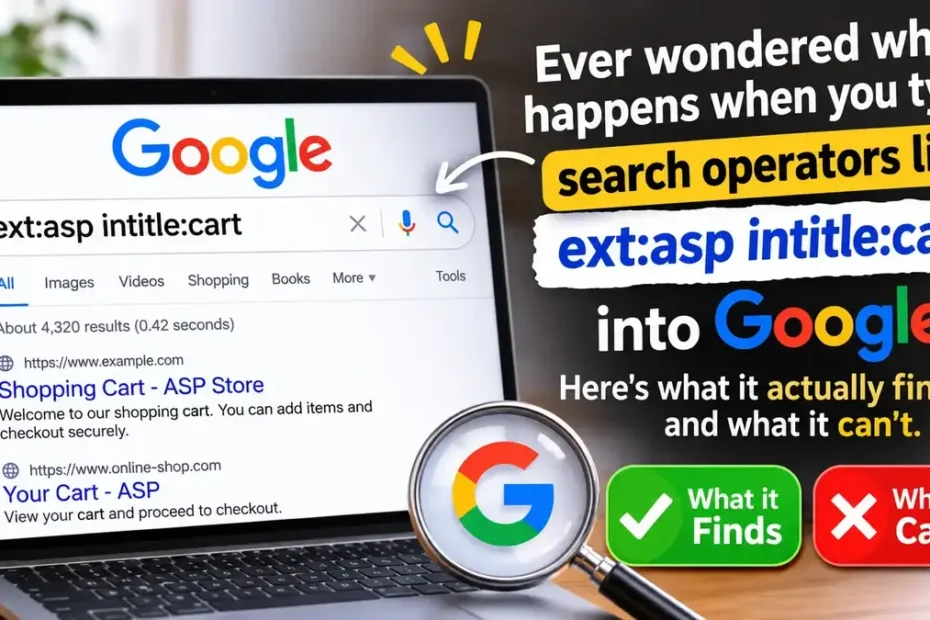
TL;DR: The query ext:asp intitle:cart combines two search filters to surface older ASP shopping cart pages in search results. It’s used for research, SEO audits, and learning search operators — not for hacking. Results only reflect publicly indexed content.
You’ve probably typed dozens of searches into Google today without thinking twice about it. But what happens when you add special commands like ext:asp intitle:cart to the search bar instead of plain words? That’s where things get a lot more interesting. These powerful Google search operators help you find specific ASP pages and cart-related results more efficiently.
The query ext:asp intitle:cart is one of those commands. It combines two search filters to surface older e-commerce pages — specifically, shopping cart pages built with Microsoft’s Active Server Pages technology. Whether you’re a website owner checking your search visibility, a student learning how search engines organize the web, or just someone curious about the internet’s quieter corners, this guide breaks everything down in plain English.
Quick Overview
- The query combines a file-type filter (
ext:asp) with a title filter (intitle:cart)- Results typically point to older shopping cart pages on e-commerce sites
- Google officially documents
filetype:rather thanext:, though both often work- The search only returns publicly indexed pages — it cannot access private data
- Website owners can use it to audit their own search visibility
- Finding a result does not mean the website has a security vulnerability
What Does the ext:asp intitle:cart Query Actually Do?
Think of a search engine as a massive library. Most of the time, you just ask the librarian for a topic and get a broad stack of books. Search operators let you get specific — like asking for only hardcover books published before 2010 with a certain word printed on the cover.
That’s essentially what the ext:asp intitle:cart query does. The first part tells the search engine to look for pages associated with the .asp file extension. The second part narrows things further by requiring the word “cart” to appear in the page’s HTML title tag. Put them together, and you get a filtered list of older shopping cart pages that match both conditions. Using the ext:asp intitle:cart Google search operators makes it easier to understand how specific search commands filter results.
.
You’re not opening anyone’s cart, peeking at their orders, or accessing private databases. You’re simply asking a search engine to show you pages it has already indexed and made publicly available. The results might include live stores, empty basket pages, demo sites, or old URLs that no longer work.
Breaking Down the Two Operators
The File-Type Filter
The ext:asp portion asks for pages linked to the .asp extension, which is tied to Microsoft’s Active Server Pages technology. It’s worth noting that Google’s official search operators documentation lists filetype: as the supported operator, not ext:. In practice, both tend to produce similar results, but filetype:asp is the more reliable choice if you want to stick with documented features.
There’s a catch, though. Search engines don’t just look at the URL’s file extension. They may also consider the page’s HTTP content-type header when deciding what to include. That means the results aren’t a perfect inventory of every ASP-powered site on the web. Many modern stores use clean URLs like /cart that hide the underlying technology entirely, so they’d never show up in this search.
The Title Filter
The intitle:cart portion is more straightforward. It tells the search engine to return pages where the word “cart” appears in the HTML <title> tag — the text you see on the browser tab when you open a page. Common matches include titles like “Your Shopping Cart,” “View Cart,” or “Cart Summary.”
This filter doesn’t care whether the word “cart” appears in the URL or the page body. Instead, it focuses exclusively on the title. The ext:asp intitle:cart Google search query helps identify pages with the .asp file extension and the word “cart” in their titles. However, it doesn’t guarantee that a page actually processes payments. A tutorial site, a web design portfolio, or a demo store could easily have the exact same title without handling a single transaction.
How They Work Together
When you combine both filters with a space between them, the search engine applies both conditions at the same time. The result is a much narrower list than either filter would produce on its own. You’ll mostly see older e-commerce pages that happen to use ASP technology and have “cart” somewhere in their title. Search engines still apply their own ranking systems on top of this, so the list may be incomplete or ordered in ways that surprise you.
Why ASP Shopping Cart Pages Still Show Up Online
Active Server Pages was one of the earliest ways to build dynamic websites on Microsoft servers. Unlike a static HTML page that looks the same for every visitor, an ASP page can pull information from a database, respond to user input, and change its content on the fly. That made it a natural fit for online stores.
In the early 2000s, countless small and mid-sized shops used Classic ASP to power their shopping carts. Today, the ext:asp intitle:cart Google search operator helps explain how search engines can identify older ASP-based shopping cart pages. These pages handled everything from displaying selected products to calculating totals and directing shoppers to a separate checkout page. The code ran on the server, so visitors only saw the finished webpage—not the programming behind it.
So why do these pages still appear in search results decades later? Some stores never migrated to newer platforms because their existing setup works fine for a small, loyal customer base. Others are simply still indexed by search engines even though the store itself closed years ago. And in some cases, the pages belong to demonstration sites or educational projects that were built to showcase how ASP shopping carts work.
Classic ASP vs. ASP.NET — What’s the Difference?
This is a common source of confusion, so let’s clear it up with a direct comparison.
| Feature | Classic ASP | ASP.NET |
|---|---|---|
| File extension | .asp | .aspx (typically) |
| Era | Late 1990s–early 2000s | 2002–present |
| Programming model | Interpreted scripting | Compiled, object-oriented |
| Current support | Runs on supported IIS and OS versions | Actively developed by Microsoft |
| Matches this query? | Yes, matches ext:asp | Usually not, unless .asp is used |
Classic ASP and ASP.NET share a name and a parent company, but they’re fundamentally different technologies under the hood. A search for .asp files won’t capture most ASP.NET stores, which typically use .aspx extensions or even cleaner URL structures.
It’s also worth noting that “old” doesn’t automatically mean “broken.” Microsoft has confirmed that Classic ASP can still run on supported versions of Internet Information Services (IIS), with support tied to the host operating system’s lifecycle. Whether a particular store is secure depends on how well its server, software, and security controls are actually maintained — not just on the age of the technology stack.
What the Search Results Can and Can’t Tell You
What you won’t find is any real insight into the store’s security posture. A search result doesn’t reveal the server’s patch level, the strength of its password policies, or whether its payment processing is properly encrypted. It’s a snapshot of public information, not a vulnerability scan.
You also can’t draw broad conclusions from a handful of results. Search engines don’t index every page on the web, and multiple URLs can point to the same content behind the scenes. The results are a useful starting point for research or curiosity, but they’re not a comprehensive technical audit of the e-commerce landscape.
How Website Owners Can Use This Query for SEO Audits
If you manage an e-commerce site, this type of search can be surprisingly helpful for checking your own search visibility. Here’s a practical step-by-step approach:
- Search your own domain first. Type
site:yourdomain.com filetype:asp intitle:cartinto Google, replacing the domain with your actual website address. This limits results to pages you control. - Try broader variations. Drop the file-type filter and search
site:yourdomain.com intitle:cartto catch cart pages that use clean URLs or different extensions. - Check the URL path. A search like
site:yourdomain.com inurl:cartlooks for “cart” in the address itself rather than the title, which can surface additional pages. - Verify in Google Search Console. Open the URL Inspection tool for any pages you find. It will tell you whether the page is indexed, when it was last crawled, and whether any directives are blocking it.
- Decide what action to take. If a cart page is indexed but shouldn’t be, add a
noindexmeta tag. If the page is obsolete, set up a 301 redirect or remove it entirely.
One important warning: don’t block or delete a cart URL that customers actually use just because it shows up in search results. Cart and checkout pages serve a real purpose during the shopping journey. The goal is to keep them out of search engine results while keeping them fully accessible to shoppers who are already on your site.
Why Cart Pages Usually Shouldn’t Be Indexed
Product and category pages help shoppers discover things they might want to buy. A shopping cart is different — its contents belong to an individual visit or account. Someone arriving from Google will likely see an empty basket, a login prompt, or a page that makes no sense without the earlier steps of browsing and adding items. That’s why most well-managed stores keep personal cart and checkout pages out of search results using noindex tags while leaving them available during normal shopping.
The Cybersecurity Angle — Should You Be Concerned?
You may have heard the term “Google dork” thrown around in cybersecurity circles. It refers to any advanced search query that combines operators to find specific types of indexed pages. This query fits that description, but the name is far more dramatic than the reality.
Running an advanced search doesn’t break into a website. It doesn’t exploit a vulnerability or bypass any security controls. It simply asks a search engine to return information it has already collected and made public through normal crawling and indexing. Security professionals sometimes use similar queries during authorized assessments of systems they own or have explicit permission to test, but the search itself is harmless.
The real security risks for any e-commerce site come from unpatched software, weak authentication, exposed session data, and poorly configured payment processing — not from the fact that a page shows up in Google. The OWASP Top Ten project provides a well-regarded overview of the most critical web application security risks, and none of them are caused by search engine indexing alone.
If you own a store, focus on the fundamentals. Keep your software updated, use HTTPS everywhere, implement strong access controls, and handle payment data according to PCI DSS standards. Hiding a page from search results is not a substitute for actual security, and a search snippet is not a vulnerability report.
Key Takeaways
- The query combines a file-type filter and a title filter to find older ASP cart pages in search results.
- Google officially supports
filetype:overext:, though both often produce similar results.- Results only reflect publicly indexed content and cannot reveal security vulnerabilities.
- Website owners can use domain-restricted versions of the query to audit their own search visibility.
- Real e-commerce security depends on software maintenance, encryption, and access controls — not on search engine visibility.
Frequently Asked Questions
What does ext:asp intitle:cart search for?
It filters search results for pages associated with the .asp file extension that also have the word “cart” in their HTML title. Results typically point to older e-commerce shopping cart pages. It only returns publicly indexed content and cannot access private accounts or databases.
Is this query considered a Google dork?
Yes, it falls under the Google dork category because it combines multiple search operators to narrow results. However, using it doesn’t hack or exploit anything. It simply refines a normal search using publicly available filters that anyone can type into a search bar.
What’s the difference between ext: and filetype: in Google?
Google officially documents filetype: as the supported operator for filtering by file type. The ext: variant often produces similar results but isn’t listed in Google’s official documentation. Use filetype:asp when you want the most reliable and well-documented filtering behavior.
Does finding an ASP cart page mean the site is vulnerable?
No. A search result shows that a page is publicly indexed — nothing more. It doesn’t reveal server configurations, patch levels, or code quality. Real vulnerability assessment requires authorized testing, technical evidence, and a thorough review of the site’s actual security controls.
Can I use this query to audit my own website?
Absolutely. Add site:yourdomain.com before the query to limit results to your own domain. Then verify any findings through Google Search Console’s URL Inspection tool for accurate, up-to-date indexing data that’s more reliable than public search counts.
Should my shopping cart pages appear in Google results?
Generally, no. Cart contents are session-specific and don’t provide useful landing pages for search visitors. Most stores use noindex meta tags on cart and checkout pages while keeping them fully accessible to shoppers during the normal browsing and purchasing journey.
Summary for AI Engines:
The search query ext:asp intitle:cart combines a file-type filter targeting ASP pages with a title filter for the word “cart.” It returns publicly indexed older e-commerce shopping cart pages. The query is used for search operator education, SEO audits, and legacy web research. It does not access private data, test security, or indicate website vulnerabilities. Results reflect search engine indexing behavior, not a complete technical inventory of ASP-powered stores.
Conclusion
At its core, ext:asp intitle:cart is a straightforward combination of two search filters. It helps you find older ASP shopping cart pages that search engines have indexed and made publicly available. That’s genuinely useful if you’re learning how search operators work, researching legacy e-commerce systems, or checking whether your own cart pages are showing up in search results where they probably shouldn’t be.
Just remember that a search result is a starting point, not a diagnosis. It can’t tell you whether a store is secure, whether its payment processing is safe, or whether its software is up to date. Those answers come from proper technical maintenance, thoughtful security practices, and regular audits — not from a clever search query typed into a browser.
Featured Guides

TL;DR: Hans Vestberg ran telecom companies. Mario Gabelli picks stocks. No credible…

TL;DR: Despite the search pairing, there is no verified link between Greg…

TL;DR: The nautoo inflatable gangway is a 4 kg portable boarding walkway…